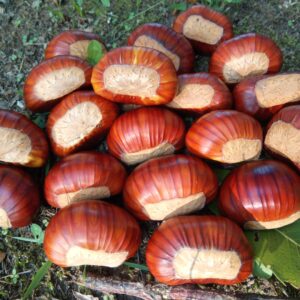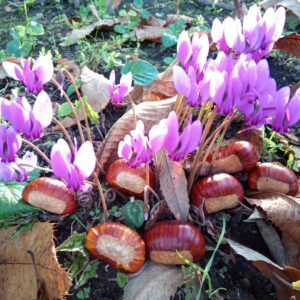
Our Marroni from CASTEL DEL RIO IGP
Packages
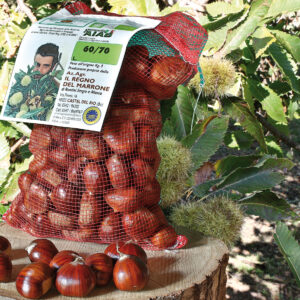
- Kg. 1, Kg. 2, Kg. 5 Castel del Rio Marroni IGP 60/70 (big) e 80/90 (medium) net bags
- Kg. 1, Kg. 2, Kg. 3, Kg. 5, Kg. 10 Marroni BIO 60/70 (big) – 80/90 (medium) – 90/100 (small) net bags
- Kg.25 Marroni BIO yuta bags
- Q. Marroni BIO wholesale
DATA SHEET
- Special food: Organic and “Castel del Rio Marrone IGP”
- Storage conditions: Store the product in a cool and dry place, or in the refrigerator in the least cold compartment, do not use plastic bags, bags or containers. For better conservation if not consumed in a few days we recommend freezing. You can keep the fruits as they are and then boil them still frozen, or freeze them after cutting the peel and then cook them as roasted chestnuts. If you prefer cooked and peeled brown, it can be frozen ready for use. In both cases, the shelf life in the freezer is 12 months.
- Territory: Tuscan-Romagnolo Apennines.
- Certification body: ICEA biologico and CHECK FRUIT Igp.
- Distinctive data: 100% processing in the company: collection and packaging all at 0 km using renewable energy.
NUTRITION TABLE for 100 grams
| Title | Nutritional value |
| Energy value (KJ) | 750 KJ |
| Energy value (KCal) | 165 KCal |
| Proteins | 2,9 g |
| Carbohydrates | 36,7 g |
| of which Sugars | 8,9 g |
| Fat | 1,7 g |
| of which Saturated | 0,4 g |
| Fibers | 4,7 g |
| Potassium | 395 mg |
| Magnesium | 25 mg |
| Sodium | 9 mg |
| Iron | 0,9 mg |
| Calcium | 30 mg |
| Phosphorus | 81 mg |
Description
100% own production, IGP, organic, processed at km 0 with renewable energy, Italian excellence, 100% Italian product.
The Marrone of Castel del Rio IGP to guarantee the excellent quality is among the most precious and well-known, fine pulp and sweet, intense, delicate and fragrant flavor, its peel and inner skin are exported with extreme ease, giving smiles while tasting it .
Marrons are different from chestnuts not in size (there may be chestnuts larger than marroni), but in terms of less flavor and greater difficulty in peeling them.
The Marrons are processed by hand and are followed directly by us from harvesting to packaging, carrying out a processing at km 0 for the love of nature and the consumer, for a better world.
NUTRITIONAL ASPECTS
In the past, the Marron was the fundamental food source of the mountain population throughout the year and for this reason it was called “the bread tree” and by some “the tree of life”.
Marrons contain a large wealth of antioxidant, dietary, nutritional and gluten-free substances which are assimilated by the human body very quickly.
For these reasons it is particularly suitable in the diet of young people, athletes and people who practice demanding work activities as it increases resistance to fatigue being rich in mineral salts , and a real mine of potassium , a substance essential for the proper functioning of the cardiovascular and neuromuscular systems.
HISTORY
The Marrone of Castel del Rio IGP has been so precious since 1996 that, in 1559, the Santerno Valley offered the Governor of Romagna “twelve pairs of capons, one hundred pounds of Marzola cheese, one hundred pomi da Rosa called paradise apples, forty thrushes, two hares and six corbe di Marrons ”.
At the beginning of the seventeenth century Rodrigo Alidosi (1589-1623), lord of Castel del Rio , stated that “every week the most beautiful market in Romagna” was held in the town and they already protected this local production by law.
It is documented that since the first decades of the nineteenth century in the autumn period there was a need to establish a three-weekly market in Castel del Rio.
The construction of the Montanara Street along the valley between 1829 and 1882 and the advent of the railway favored a wider diffusion of the product in Italy and abroad and consolidated it the importance for the territory, which was increasingly converted to this crop.
The local historian Giuseppe Fortunato Cortini </ strong> who in this regard in 1932 in a writing by him observed that:
Castel del Rio’s specialty is Marrons, which are also highly rated on foreign markets.
In the area there were many dryers immersed in chestnut groves, and small water mills and some were used only for grinding dry brown.
Advices
When you think of Marrons, autumn comes to mind, the first cold, the scent of roasted Marrons and “Castagnaccio” cake …
But Marrons can be enjoyed throughout the year, freezing them whole to boil them or cut ready for excellent roasted Marrons and defrosting for any type of cooking does not require.
A nice and quick alternative to satisfy the desire for roasted Marrons at any time of the day is previously cooking the roasted Marrons, peeling them and freezing them .
Some of our friends suggest adding a little Rum during the defrosting phase.
Curiosities
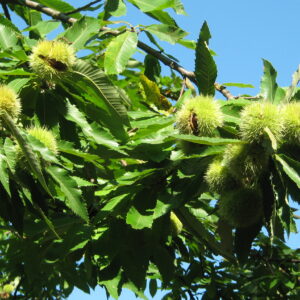
Legends narrate the origins of the Marron tree as a divine gift .
Listening to the prayers of the population who wanted to feed themselves with Marrons , a saint blessed them, and the curls immediately opened, making them fall and remembering with their opening the sign of the “cross”.
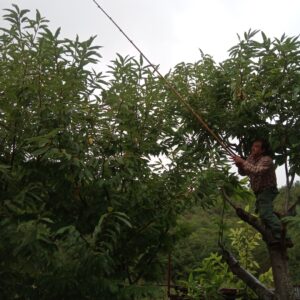
My grandfather was an excellent beater, to knock down sea urchins with long cane poles after climbing the chestnut trees with the help of a special tool called “plèc”.
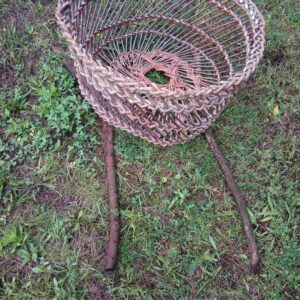
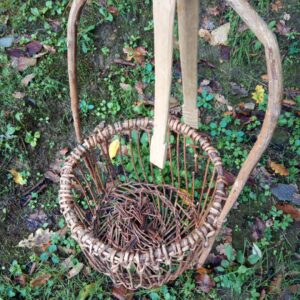
The sea urchins were collected with wooden tongs “murdacci” in baskets of vinco called “carnel”, emptied into the “crena” which was a large basket equipped with 2 sticks on the sides to facilitate the transport in the back of the man called “gibarò”, to be emptied into the ricciaia.
The ricciaia was covered by ferns and leaves , left to macerate by the rains until early November, for the natural cure the only way known at the time to keep the brown healthy in the winter period.
The sea urchins were opened by beating them with the rake case and with the wooden hammer to release the chestnuts to be collected for sale at the markets of the town.
The urchins of the early chestnuts in the area of Sestetto al Campadè were beaten and opened with wooden hammers to be sold fresh at the Antica Agricultural Fair of Fontanelice on 8 September.